
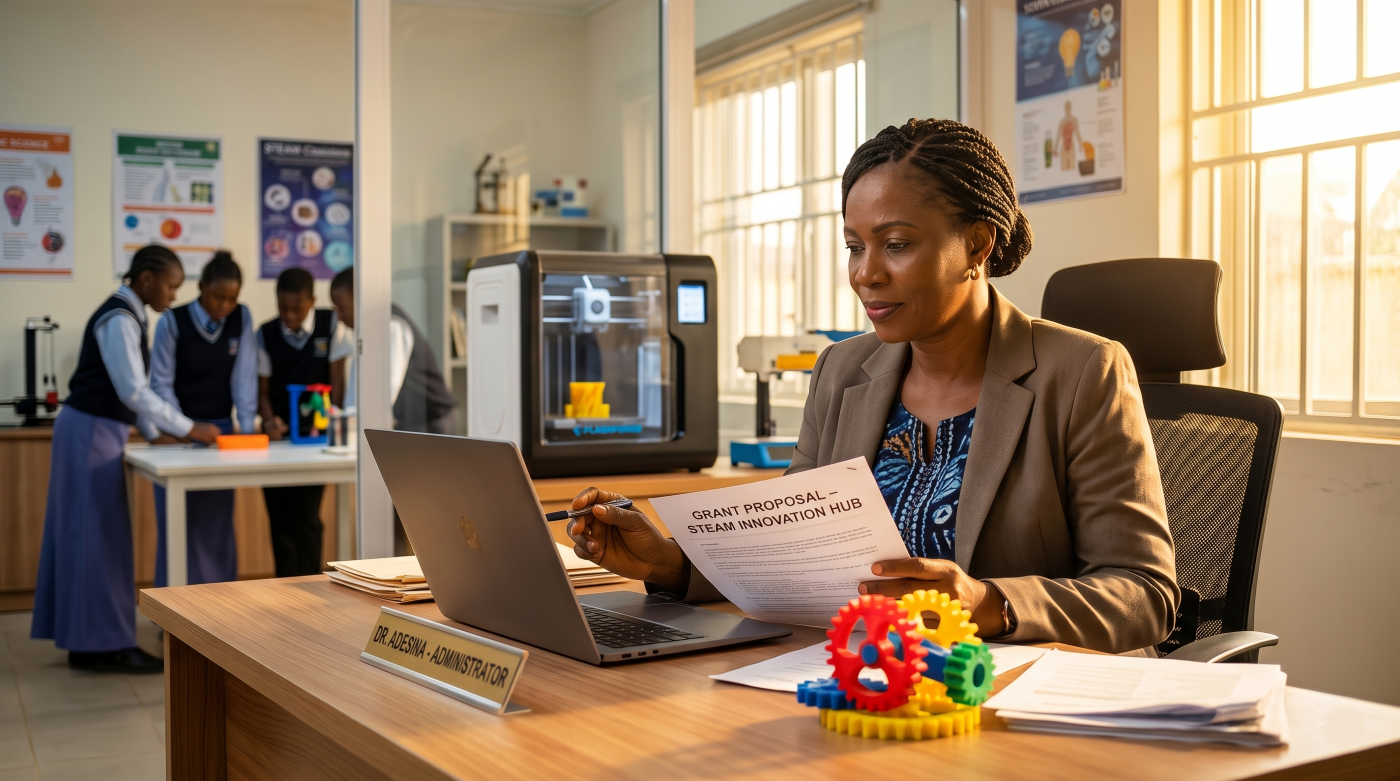
However, understanding the return on investment is only half the battle. The most significant hurdle schools face is securing the initial capital to procure this modern infrastructure.
Fortunately, a growing ecosystem of public-private partnerships, NGOs, and corporate social responsibility (CSR) initiatives is actively looking to fund technology in African classrooms. To access these funds, you need a compelling narrative. Here is your definitive guide to writing a winning grant proposal to equip your school’s STEAM lab.
1. Frame the Problem: The Critical Skills Gap
Grant reviewers do not fund hardware; they fund solutions to pressing socio-economic problems. Do not start your proposal by asking for a 3D printer. Start by outlining the critical engineering and design skills gap in the modern Nigerian workforce.
Explain how traditional, rote-based learning limits students' ability to solve real-world problems. Position your school as a forward-thinking institution eager to transition from theoretical memorisation to experiential learning. Your proposal must clearly articulate that by acquiring digital manufacturing infrastructure, you are not just buying a machine—you are democratising access to the global digital economy for your students.
2. Define Clear, Measurable Objectives (Idea to Impact)
Funders want to know exactly how their investment will be utilised. Structure your objectives using the SMART framework (Specific, Measurable, Achievable, Relevant, Time-bound).
Instead of stating, "We will teach students about 3D printing," write, "By the end of the first academic year, 150 Senior Secondary students will have designed, prototyped, and printed a functional solution to a local community problem, integrating physics, mathematics, and design principles." Detail how the technology will be cross-pollinated across various subjects. Will biology teachers print anatomical models? Will mathematics educators print geometric representations of abstract formulas? Paint a vivid picture of the multidisciplinary innovation the grant will unlock.
3. Emphasise Localised Support and Sustainability
The fastest way to have a grant application rejected is to present an unsustainable project. Historically, many African schools have received grants for imported technology, only for the machines to break down within months and become e-waste due to a lack of local technical support.
This is where your choice of equipment vendor becomes your greatest asset. In your proposal, explicitly state your intention to procure hardware from an authorised regional distributor. For instance, Generative CAD is the official distributor for Flashforge in West Africa.
Specify that you will be deploying educational 3D printers like the Flashforge Adventurer 5M, which feature fully enclosed safety parameters ideal for classrooms. Furthermore, highlight that this procurement includes localised maintenance, authorised warranties, and operational continuity. Funders will appreciate that you have mitigated the risk of equipment downtime.
4. Prioritise Educator Training
The most sophisticated STEAM lab will fail if the teachers do not know how to utilise it. A winning grant proposal allocates a specific portion of the budget to continuous educator empowerment.
Detail your plan to upskill your teaching staff. Explain how you will partner with institutions like the Generative CAD Academy to provide your teachers with pedagogical strategies, ensuring they can seamlessly integrate CAD software and additive manufacturing into their existing lesson plans. Showing that you are investing in human capital alongside physical infrastructure significantly boosts your proposal's credibility.
5. Provide a Transparent, Itemised Budget
Ambiguity is the enemy of funding. Provide a meticulously detailed budget that outlines the entire ecosystem required for a functional STEAM lab. Use our foundational guide on how to equip a future-ready STEAM lab to structure your costs.
Your budget should clearly itemise:
Hardware: Desktop 3D printers built for education (e.g., Flashforge Adventurer series).
Software: Industry-standard CAD educational licenses (Autodesk or SolidWorks).
Consumables: Non-toxic, high-yield materials like PLA Pro Filament.
Capacity Building: Specialised STEM educator training programs.
Maintenance: Localised support and warranty packages.
Partner With Us for Your Grant Application
Securing funding for educational infrastructure requires a compelling vision backed by reliable execution. At Generative CAD, we are passionate about forging public-private partnerships to democratize engineering design across Africa.
If your institution is preparing a grant proposal, we can help. We provide official quotes, detailed technical specifications, and comprehensive infrastructure planning to support and strengthen your application. Let us work together to turn your bold vision into real-world impact.
📍 Visit us at: 26, Akinwale Street, Off Yaya Abatan Road, Ogba, 100218, Lagos, Nigeria
📧 Email: info@generativecad.com
📞 Call/WhatsApp: +234 703 324 8607
Empowering Africa’s innovators, educators, and builders to create a better tomorrow.

 Search